Posts

Showing posts with the label National Heritage Sites

Swartberg Pass

Image
In October 2015 we took a short trip to Prince Albert.  We ended our trip by driving back home using the Swartberg Pass. The Swartberg pass was the final pass built by Thomas Bain and was opened on 10 January 1888.  The pass is a gravel road of about 27 km from Prince Albert to Oudshoorn over the Swartberg Mountains. The pass has many with lots of switchbacks with beautiful views.  The road is supported by an amazing stone retaining walls. It declared a National Monument in 1988. The pass was very busy on the Sunday morning as we made our way home.  At some places the road is very narrow and one of the vehicles has to stop for the other to pass.  I was very glad that I was not in the driver seat but my husband did a great job.  It is not necessary for a 4x4 vehicle to do this drive. We used our in our Ford Figo and saw even smaller cars also driving along.     We first stopped at my parents hous...

Old Water Mill, Prince Albert

Image
Our last stop in Prince Albert was the Alberts Mill.   Driving out of town it can be found on the left side of the road.  This water mill was built in 1850 by HJ Botes.   It is the last of 7 mills that used to operate in Prince Albert.  From 1842 grain was milled at the site but the current building is from 1850.  After being operated as a flour mill for more than 100 years it was sold in 1977.  The mill slowly deteriorated but in 2000 it was restored and can once again ground flour. It was declared a  National monument in 1965 . For more information visit  "Prince Albert Friend"

Dias Museum Complex

Image
I live in Mossel Bay. The town is next to the ocean and it is a very popular vacation destination during summer.  From mid December to early January it is very busy and we try to stay away from the shops and tourist places during the day. So when things started to calm down after New Year I decided to take my 2.5 year old son (JW) to visit the Dias Museum Complex.  My last visit to the museum was in 2012 when I went during my lunch hour.  This time we arrived at about 10:00 and spend about 90 minutes at the museum.  (There was still more to see but after 90 minutes my son was getting tired and we went home) The entrance fee is R 20 for an adult to visit the museum or R 40 to visit the museum and go onto the replica of the carvel.  Children are divided in 2 categories.  There was no fee for JW.  (I think children start to pay from 6 years and older) Entrance fees are paid in the Granary and we then walked through the building to the re...

Prince Albert Gable

Image
I started to post about our short trip to Prince Albert in October 2015 but did not finish.  Before visiting Prince Albert we did not know a lot about the town. It was bigger than we expected and there were a lot of old buildings to photograph.  Fransie Pienaar Museum One of our first stops was at the Fransie Pienaar Museum. This was n very interesting museum about the history of the town.  Unfortunately they do not allow photos inside the museum.  My fingers itched to take photos.  There is a small shop in the museum but I was disappointed that they did not postcards or photos about the museum’s collection. The museum shop did have very interesting small books about the town written by Helena Marincowitz.  We bought two books: “Prince Albert and the Anglo Boer War” and “The Old Gables of Prince Albert”.  This is when we learned about the Prince Albert Gable. The gable style was brought to South Africa by the settlers from Holland....

Ostrich Feather Palaces

Image
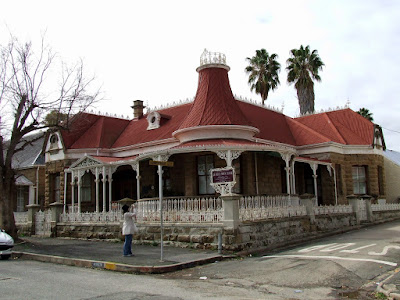
Oudsthoorn became known world-wide due to the ostrich feather industry.  From about 1860 it was high fashion for ladies to use ostrich feathers as decoration on their outfits.  Between 1900 and 1914 the price was unbelievable high and the farmers and merchants in Oudtshoorn reaped the rewards. Numerous immigrants, particularly the Jews, were drawn to the “boom” town. Soon a rivalry started between the farmers and merchants to see who could build the most beautiful homes or “ostrich feather palaces”.  Beautiful homes were built with stained glass windows, cast-iron work (“broekielace”) and turrets. Here are a few of the ostrich palaces we found while walking in Oudtshoorn in Aug 2013:   Le Roux House ( 46 High Street) The house was built for JHJ le Roux.  It was designed by Char les Bullock and was built during 1909 and 1910.  It is now part ot the CP Nel Museum but the ouside of the building look terrible.  The museum was closed and...

Hangbrug, Oudtshoorn

Image
As a child, a highlight of a trip to Oudtshoorn was to walk over the suspension bridge or “hangbrug” in Afrikaans.  So naturally when we visited Oudsthoorn in August 2013, I wanted to walk over the bridge.    A bit of history about the suspension bridge: Oudtshoorn developed on both sides of the Grobbelaars River.  In 1913 the town council approved the building of a suspension bridge at Church Street. It was constructed by Rowlay and Sons in London and it was completed in 1914. The suspension bridge is 91 meters long with 9 meter high towers at each side. It was declared a National Monument in 1964. H decided to keep his feet on solid ground but I decided to take a walk over the bridge.  The bridge is a lot longer than I remember but it was fun.  The swing of the bridge while walking was fine except for when a few young men decided to run over the bridge past me making the bridge swing. I will think I need to keep with traditi...

Dutch Reformed Mother Church, Oudtshoorn

Image
One of our stops when we visited Oudtshoorn was the Dutch Reformed Mother Church on the corner of High Street and Church Street.   Unfortunately the gates to the church grounds was locked and we could not take a closer look or visit the inside.   The foundation stone was laid on 15 January 1861 but work was stopped in the 1860’s due to the lack of money and a problem due with the wall because the plans were read incorrectly.   In 1876 Carl Otto Hager was appointed to complete the church and work stared again.   The church was complete and consecrated in 1879.   It was built from local sandstone and is a national monument.    The hall next to church was completed in 1895. For more detail about the history in Afrikaans read here .