Posts

Showing posts with the label Grahamstown

Grahamstown : Old buildings

Image
Today is my last post about our three days in Grahamstown.   It was our first visit to this city and we enjoyed it.   We also enjoyed our stay as the Colonel Graham Guest House .   But before I tell you about the rest of our trip in the Eastern Cape, here is a few photos of other old buildings in the town. Grocott's Mail This building with is beautiful facade was declared a National Heritage Site in 1984.   The original façade was destroyed in a fire in 1906 and it was replaced with the current gabled front. City Hall The City Hall and Settlers’ Memorial Tower in High Street is a National Heritage site.   The foundation stone for the Memorial Tower was laid as celebration for the 5oth anniversary of the 1820 British Settlers.   After struggling to complete the tower it was decided that the tower should be part of the town hall.   The Town Hall was opened in 1882. City Hall Memorial Tower ...
Grahamstown : Schools

Image
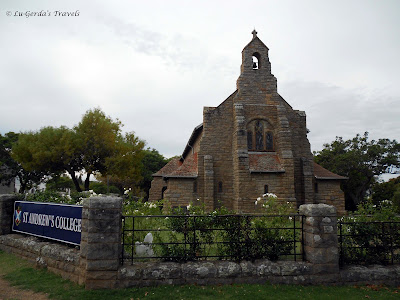
Grahamstown has some very old schools with beautiful school grounds.   We drove around and visited some of the schools. St Andrew’s College St Andrew’s College is a private school for boys and was founded in 1855 by Bishop John Armstrong.   Although the school has an Anglican foundation, they accept pupils from all religions. The beautiful College Chapel was designed by Sir Herbert Baker and was consecrated in 1914.   The Memorial Clock Tower was opened on 30 November 1923 and is a monument to the Andreans who nobly sacrificed their lives in the First World War. College Chapel The Memorial Clock Tower The Memorial Clock Tower Diocesan School for Girls Diocesan School for Girls is a private school for girls.   It was founded in1874 by Bishop Merriman and is one of the oldest girl’s schools in South Africa. Kingswood College Kingswood College was founded in 1894 as an independent school for girls and boys.   It is one...

Grahamstown : Churches

Image
Grahamstown is also known as the “City of Saints” with 52 Churches of numerous denominations in the town.   We already visited the Commemoration Church , the Cathedral of St Michael and St George , the Baptist Mother Church   and St Bartholomew . On the 1 May we went for a drive in the town looking for more churches.   Here are some of them: St Philip’s Anglican Church This isiXhosa-medium church was built in 1860 for the mostly refugee population.   In front of the church the burnt remains of St Phillips Hall, once a school building, can be seen. Christ Church Christ Church was built from a bequest from Rosa Wright and was opened for worship in 1867 Synagogue A plaque on the outside of the synagogue gives the following information: “The synagogue was consecrated on 19 Aug 1913 to serve the growing Jewish community of Grahamstown. Jews first settled in Grahamstown with the arrival of the 1820 Settlers, worshipping in tempo...

Grahamstown : Rhodes University

Image
After walking around in the Artisan Quarters we drove to the Rhodes University and walked on the campus.   I was very surprised at how neat and pretty it was.   We also enjoyed all the historical buildings we found on the campus. Rhodes was founded in 1904 and was named after Cecil John Rhodes .   The university bought the Drostdy building from the British Government and in the beginning of 1905 the university moved in. Drosdy Gateway Drosdy Bell The Drosdy Gateway was designed by major C.J. Selwyn in 1835 and built by the Royal Engineers in 1842.   It was the entrance to the military establishment on the unused Drosdy grounds and now the Rhodes University.   The wooden posts on the sides of the entrance were to protect the walls from damage when carriages entered the gate. Behind one of the walls of the gate is a information board about the gate and the Drosdy Bell.   This bell used to be at the top of the gateway,   From 1842 unti...

Grahamstown : Artisan’s quarter

Image
The next day in Grahamstown was a public holiday and the museums were closed.   We started the day by driving to the Artisan’s quarter and walking around for a while. The British Settlers were not farmers and soon after arriving they started to move from their farms into the town.   This area of Gramhamstown developed from 1823 when from these Settlers.   The lots and houses were small.   It was named the Artisan’s Quarter after the inhabitants who were skilled artisans or "artificers". Cobbled gutters and Wagon Stone The artisan’s quarter has many restored Settler houses form the 1820’s.   There are streets full of these houses and many have been declared National Monuments.   The cobbled gutters still exist and on the street corners there are still some wagon stones to protect the houses form damage by passing wagons. An interesting building was the Baptist Mother Church.   From the outside the building does not look lik...

Grahamstown : Gunfire Hill

Image
We had a very busy day in Grahamstown.   We started the day by visiting the Cathedral .   Then we visited a few Museums: The History Museum , National English Literature Museum and Observatory Museum .   We then drove to Gunfire Hill where we saw Fort Selwyn . While searching for the Settler Monument we passed the Astronomical Toposcope.   The marks shown by the stones this toposcope includes: the four point on a compass; sunrise and sunset at spring and autumn equinoxes; and sunset at summer and winter solstices. We then found the Settlers monument.   It was at the other side of the parking.   The monument commemorates the 1820 Settlers who settled the Eastern Frontier of the Cape Colony. On out way down from Gunfire Hill we pasted the Old Provost Prison.   The prison was designed in 1835 by the Royal Engineers.   The cells are arranged in a semicircle and has a guard-h...